
You could be watching MCrider videos ad-free. Find out how.
If you are an ad-free member make sure to log in to see your ad-free video.
How Much More Dangerous Is It to Ride a Motorcycle vs. Driving a Car?
This week on MCrider, we’re taking a close look at the numbers — how car safety has improved dramatically since 1975, what has (and hasn’t) changed for motorcycles, and what you can do to reduce your personal risk on two wheels.
Car Safety Has Improved Dramatically
Over the long haul, risk per mile in cars is way down.
The death rate per 100 million miles traveled has fallen by roughly 62% since 1975 — from 3.35 to 1.26 in 2023.
So, what led to this huge leap in safety for drivers and passengers?
1. Seat Belts and Airbags
- Seat belts became federally mandated in U.S. cars in 1968, and three-point belts are now standard.
- Airbags started appearing in the 1980s and became mandatory for front seats in 1999. Side-impact and curtain airbags followed.
- Combined, these cut fatality risk by over 45% for drivers and 50% for front-seat passengers in serious crashes (NHTSA).
2. Crashworthy Vehicle Design
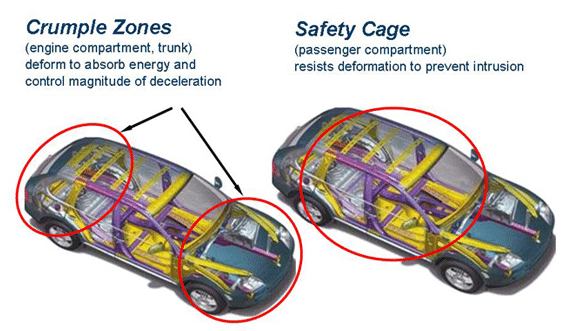
- Crumple zones and reinforced passenger compartments absorb impact forces instead of transferring them to occupants.
- Federal Motor Vehicle Safety Standards (FMVSS) began requiring front and side crash tests in the 1970s, forcing automakers to design safer structures.
3. ABS and Electronic Stability Control (ESC)
- ABS, mandated in the late 1980s/1990s, reduces loss-of-control crashes by preventing wheel lockup.
- ESC, required starting in 2012, is one of the biggest lifesavers. Studies show it reduced single-vehicle fatal crashes by more than 50% (IIHS).
4. Improved Child Restraints
- Mandatory child safety seats (1970s–1980s) and LATCH systems (from 2002 onward) drastically improved protection for young passengers.
- Pretensioners and load limiters now help manage crash forces across a wider range of body types.
5. Advanced Safety Technology
Over the last 15–20 years, collision-avoidance systems have become widespread:
- Forward Collision Warning & Automatic Emergency Braking (AEB)
- Lane Departure Warning / Lane Keep Assist
- Blind Spot Monitoring
All of these technologies have made cars and trucks significantly safer.
Motorcycle Safety: More Limited Progress
During this same time, motorcycles have seen some improvements — but nowhere near the level of cars.
1. Helmet Standards and Usage
- The DOT helmet standard was introduced in 1974.
- Modern helmets use better materials (fiberglass, carbon, Kevlar), EPS foam liners, and improved visors.
- Helmets remain the single most important piece of protective gear for riders.
2. Motorcycle ABS
- First introduced by BMW in the late 1980s, ABS is now common on new bikes and mandatory in the EU since 2016 for >125cc motorcycles.
- NHTSA and IIHS studies show ABS reduces fatal crash involvement by 22–31% (IIHS).
3. Traction Control & Electronic Rider Aids
- Many modern bikes now include traction control, stability control, ride modes, and wheelie/launch control.
- These systems prevent loss of control by regulating throttle and braking — especially valuable in poor riding conditions.
4. Better Lighting and Visibility
- LED headlights, daytime running lights, and adaptive cornering lights have replaced weak halogen bulbs.
- These upgrades significantly improve rider visibility to other motorists.
The Reality: Risk Is Still Far Higher for Riders
Despite these improvements, per-mile risk on a motorcycle remains about 28× higher than in cars.
Unlike car drivers, riders can’t rely on society and manufacturing alone to make them safer.
The Most Important Factor: You
In my opinion, the single most important thing you can do to improve your safety on a motorcycle is to:
Develop and maintain your riding skills, and ride in a way that you rarely have to use them.
Simply put: Road Skills and Road Strategy.
For nine years on MCrider, I’ve been preaching the importance of both. Many of you have written to say that what you’ve learned here has made a difference.
Resources to Help You Ride Safer
I’ve written two books designed to help riders improve:
- The MCrider Field Guide – Parking lot exercises you can do on any open lot to build real riding skills.
- The Road Strategy Book – Strategies to help you stay out of dangerous situations on the street.
You can get them directly from me or through Amazon. The content is exactly the same — the only difference is where you buy.
In addition, MCrider Members get access to a community of riders who are dedicated to becoming better, safer motorcyclists. Training, gear, and strategy together can make a real difference in your personal risk.
Final Thoughts
Motorcycle safety has improved — but not at the pace of cars. That means your safety is in your hands:
- Wear proper protective gear
- Get training and keep training
- Ride with smart road strategy to stay out of dangerous situations
Till next week…
Ride safe, ride smart.
Links you may be interested in:
Become a Member of MCrider
Get the Field Guide Print Edition
Order ANYTHING on Amazon and Support MCrider
Braking Tips
Entry Speed
Head & Eyes
Slow – Look – Press – Roll
Trail Braking
Following Distance
Police Skills
Riding Under the Influence
Become a Member for immediate access to the MCrider Field Guide.
Below is some gear that I ride with on a daily basis…if you are in the need of good riding gear, the products below have worked well for me.
KLIM Jacket – https://www.MCrider.com/KLIM
Shoei Motorcycle Helmets – https://www.MCrider.com/Shoei
Windshirt/Jacket Liner – https://www.MCrider.com/Liner
Lee Park Sumo Gloves – https://www.MCrider.com/LeeParks
The best source for guiding your practice session is the MCrider Field Guide.
If you are not a Member join for immediate access to the forums and Field Guide