
You could be watching MCrider videos ad-free. Find out how.
If you are an ad-free member make sure to log in to see your ad-free video.
ABS Isn’t the Enemy of Skill
I’ve heard this line more times than I can count in classes and online over the years: “ABS just interferes with the braking system.” To some riders, that sounds right, especially if you learned to ride before bikes were packed with electronics. There’s this idea that ABS gets in the way of real skill, that it’s something you fight against when things get intense.
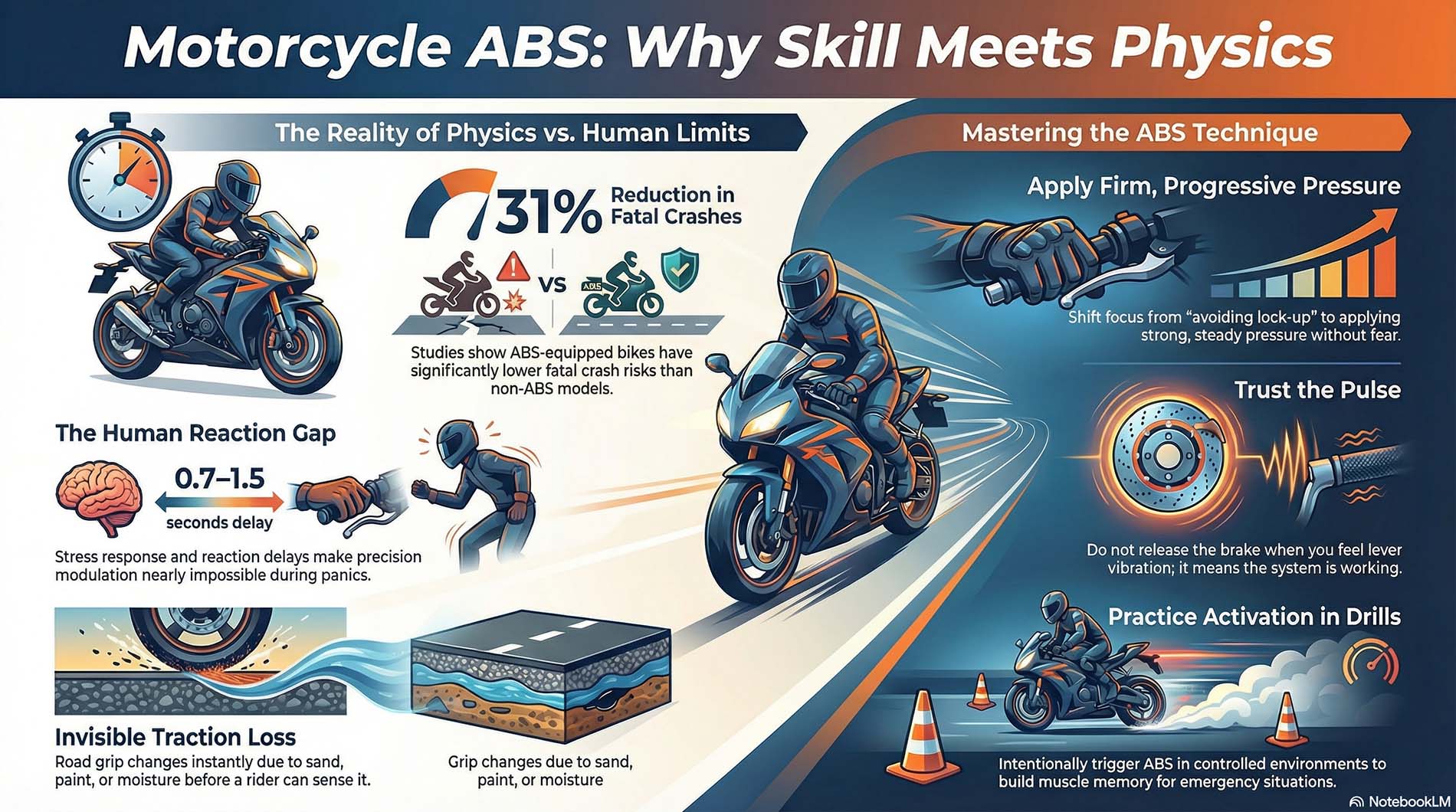
But here’s the uncomfortable truth. In the moments that matter most, panic stops, surprise hazards, bad traction, your brain and hands are not as fast or as precise as you think they are. ABS isn’t there to replace good braking technique. It exists because human reaction time, fear response, and changing road grip create gaps between what we intend to do and what the tires can actually handle. Those gaps are where front wheels lock, bikes go down, and riders lose control.
So if ABS is “interfering,” the real question becomes interfering with what, bad outcomes, or poor braking skills? When you understand what ABS actually does, it stops feeling like an obstacle and starts making sense as a tool.
Why Skilled Riders Still Lose Braking Battles
Skilled riders don’t lose braking battles because they don’t know how to brake. They lose them because real-world braking doesn’t happen in a calm, controlled environment.
On the street, braking usually comes with surprise, limited time, imperfect traction, less-than-perfect body position, and a nervous system flooded with stress. Even highly trained riders experience a delay between seeing a threat and applying maximum effective brake pressure. Stress pushes people toward either over-braking or hesitation. The exact moment you need precision the most is when your nervous system is least precise.
On top of that, traction isn’t constant. The grip available at your front tire changes with pavement texture, temperature, sand, gravel, paint lines, moisture, and even small changes in lean angle. Riders don’t feel traction disappearing until it’s already disappearing. By the time your hands sense the front starting to slide, physics is already ahead of you.
This is where skilled riders still lose braking battles. Not because they lack technique, but because human perception and reaction are slower than how fast traction can vanish. ABS works in that narrow window where things go wrong. It can release and reapply brake pressure faster than a human ever could, without panic, without hesitation, just responding to what the tire is actually doing.
Skill still matters. Technique still matters. Training still matters. But in real traffic, with imperfect roads and imperfect humans, braking isn’t just about what you know. It’s about what your nervous system can do under pressure and what the tire can support in that exact moment.
What ABS Actually Gives You on Bad Surfaces
Bad surfaces are where good riders get humbled. Not because they don’t know how to brake, but because traction changes faster than a human can adapt to it.
Gravel at an intersection, sand washed into the lane after a storm, painted lines, wet leaves, diesel spills, polished concrete at gas stations, none of these look dramatic, but all of them quietly steal grip right when riders are asking the most from their tires.
On clean, dry pavement, a skilled rider can brake hard and modulate pressure smoothly. But the street is rarely perfect. Traction can drop from one tire rotation to the next. Your hands don’t get a warning when that happens. You find out when the front starts to push.
ABS doesn’t create traction. It doesn’t give you more grip than the road can offer. What it does is let you use all the grip that’s actually available in that moment without crossing the invisible line into wheel lock.
On mixed or unpredictable surfaces, that matters. One moment you’re on clean asphalt, the next your front tire rolls across gravel or a painted stripe. Without ABS, that transition can instantly overwhelm your braking input and lock the wheel. With ABS, the system reduces pressure just enough to keep the tire rolling, then reapplies braking as grip returns.
Riders often talk about “feeling” for traction, but traction loss on the street is sudden, localized, and often invisible until it’s already happening. ABS lives in that tiny window between grip and no-grip. Skill tells you where and when to brake. ABS helps you keep braking when the road stops behaving the way you expected.
How ABS Changes Your Braking on the Street and in Practice
ABS changes what good braking looks like in the real world.
On older bikes, riders were taught to brake right up to the edge of lock-up and live in that narrow window. The fear of locking the front wheel shaped habits, sometimes squeezing too carefully and leaving braking performance on the table.
With ABS, the job of preventing wheel lock is no longer on your fingers alone. That doesn’t mean you grab the brake mindlessly. It means your goal shifts from “don’t lock the wheel” to applying strong, progressive braking without fear of tire lockup.
On the street, this changes how riders should think in emergency situations. When something pulls out in front of you, the correct response on an ABS-equipped bike is firm, progressive brake pressure and staying on the brakes even when you feel pulsing at the lever. That pulsing isn’t failure. It’s the system doing exactly what it’s designed to do.
One of the most common rider errors with ABS is easing off the brake when the pulsing starts. That reflex comes from years of being taught that vibration at the lever means you’re about to lose the front. With ABS, it means you’re at maximum braking. Backing off is how riders turn near-misses into collisions.
This also changes how you should practice. If you never feel ABS activate in training, the first time you feel it will probably be in traffic. That’s the worst possible classroom. Practicing hard braking in a controlled environment until you experience the pulsing and noise of ABS teaches your brain that the correct response is to keep squeezing, keep your eyes up, and keep the bike upright.
ABS doesn’t make braking automatic. It changes what the rider’s job is during braking. That’s not laziness. That’s using the tools your motorcycle was engineered to give you.
Conclusion: Modern Tools, Timeless Fundamentals
ABS isn’t a crutch. It’s a reality check.
It doesn’t make riders invincible. It doesn’t replace judgment, awareness, or good road strategy. What it does is acknowledge something honest about riding. The street is unpredictable, traction changes without warning, and human reaction time has limits. ABS exists to close the gap between what riders intend to do under pressure and what the tires can actually support in that moment.
The goal is to ride well using all the tools available to you. When you understand what ABS is actually doing, you stop fighting it and start using it. You brake more decisively. You manage space and timing better. You build habits around real-world traction instead of ideal conditions.
That’s how modern tech strengthens old-school fundamentals instead of replacing them.
Links you may be interested in:
Become a Member of MCrider
Get the Field Guide Print Edition
Order ANYTHING on Amazon and Support MCrider
Braking Tips
Entry Speed
Head & Eyes
Slow – Look – Press – Roll
Trail Braking
Following Distance
Police Skills
Riding Under the Influence
Become a Member for immediate access to the MCrider Field Guide.
Below is some gear that I ride with on a daily basis…if you are in the need of good riding gear, the products below have worked well for me.
KLIM Jacket – https://www.MCrider.com/KLIM
Shoei Motorcycle Helmets – https://www.MCrider.com/Shoei
Windshirt/Jacket Liner – https://www.MCrider.com/Liner
Lee Park Sumo Gloves – https://www.MCrider.com/LeeParks
The best source for guiding your practice session is the MCrider Field Guide.
If you are not a Member join for immediate access to the forums and Field Guide