
You could be watching MCrider videos ad-free. Find out how.
If you are an ad-free member make sure to log in to see your ad-free video.
Why the First Ride After Ice Is More Dangerous Than the Storm
Over the last week, a huge part of the country has been locked down by snow and ice. Here in the Dallas–Fort Worth area, we’re not exactly built for it. Roads iced over, traffic stopped, and most motorcycles stayed parked where they belonged.
Now the snow is melting.
The ice is gone.
The roads start to look clear again.
And this is the most dangerous moment for riders.
Not during the storm — after it.
Because the road can look perfectly safe long before it actually is.
What’s left behind after ice doesn’t announce itself. You can’t always see it. You don’t feel it until it’s too late. And the first warm, sunny day after a storm is when a lot of riders go down — not because they were reckless, but because they trusted the pavement too soon.
This is why the first ride after ice is more dangerous than the storm itself — and what’s really happening to the road as it comes back to life.
1. The Road Looks Clear Before It’s Actually Safe
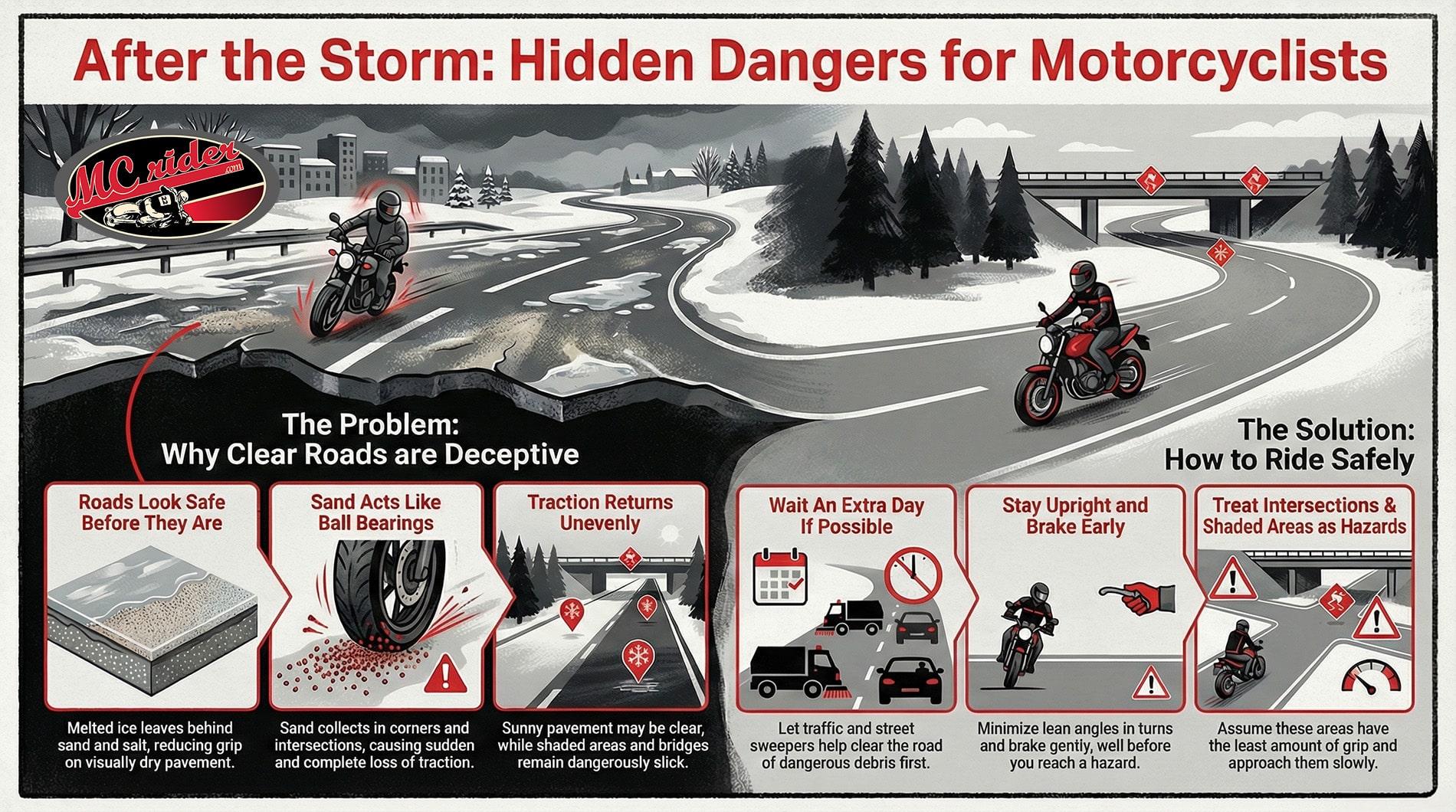
When ice melts, the road is the first thing that lies to you.
Visually, everything looks fine. Pavement is dark again. Lanes are open. Traffic is moving. It feels like the storm is over and normal motorcycle riding rules apply.
But traction doesn’t come back when the ice disappears.
It comes back later.
During snow and ice storms, road crews spread salt, sand, and brine to keep cars moving. When the ice melts, those materials stay on the surface — especially at intersections, corners, and the exact places motorcycles need grip the most.
Here’s the problem: your eyes are trained to trust dry pavement.
If it looks dry, your brain assumes it’s safe.
But after a storm, “dry” only means not frozen. It doesn’t mean clean. It doesn’t mean high-traction. And it definitely doesn’t mean predictable.
That’s why riders go down on the first sunny day after a storm. Not because they’re riding fast — but because they’re riding like it’s normal again, when the road still isn’t.
2. Sand Acts Like Ball Bearings Under a Motorcycle
One of the biggest dangers left behind after ice storms isn’t snow or water.
It’s sand.
Road crews spread it everywhere for cars — and it works great for four tires. But for motorcycles, sand is the opposite of traction.
It collects in the worst possible places:
- Corners
- Intersections
- Lane edges
- Wheel tracks
When your tires roll onto it, there’s nothing to bite into.
You don’t feel it until you lean.
You don’t notice it until you brake.
And when you do, grip disappears instantly — not gradually.
That’s why post-storm motorcycle crashes often look sudden and confusing. The rider didn’t do anything extreme. The road just gave up without warning.
3. Traction Returns Unevenly, Not Gradually
Many riders assume traction comes back like a dimmer switch slowly turning up.
It doesn’t work that way.
- Sunlit pavement dries quickly
- Shaded corners don’t
- Open roads clean up faster
- Intersections stay dirty
- Asphalt warms up
- Bridges don’t
You can have good grip for 500 feet… then hit a slick patch mid-turn.
Same speed. Same lean. Completely different result.
That’s what makes the first ride back so deceptive. The road gives you just enough confidence to relax — then takes it away in the worst possible place.
The storm might be gone.
The danger isn’t.
How to Ride After the Storm
If you want to stay upright, timing and posture matter as much as skill.
Wait a day if you can.
The first dry day is still a dirty day. Let traffic, sun, and street sweepers do some cleanup before you trust the road.
Start slow and stay upright.
Avoid aggressive leaning for the first few miles. Keep the bike as vertical as possible, especially in corners and intersections.
Brake early and gently.
Assume every stop has less grip than it looks like. Get your braking done while the bike is upright, before the corner, not in it.
Treat intersections like they’re still icy.
That’s where sand, salt, oil, and driver mistakes all pile up. Approach slower and leave yourself an escape path.
Avoid shaded areas and bridges if possible.
If it hasn’t seen sun, assume it hasn’t recovered yet — even if everything else looks fine.
This approach alone eliminates a huge chunk of post-storm motorcycle risk.
Final Thoughts: The Road Lies After the Storm
Snow and ice make danger obvious.
The days after a storm are quieter — and that’s why they catch riders off guard.
The road looks normal.
Traffic feels normal.
Your instincts say it’s time to ride like it’s normal again.
But normal is what gets riders hurt.
Smart motorcycle safety isn’t about being brave. It’s about timing. It’s about reading the road as it actually is, not how it looks from the seat. And it’s about slowing things down when the environment hasn’t caught up yet.
That’s what road strategy really is — adjusting your riding to conditions before they punish you for ignoring them.
If you want to go deeper, the MCrider Field Guide teaches the core riding skills that keep you upright when traction is limited, and the Road Strategy book shows you how to read situations before they turn into emergencies.
The road always tells you what it’s going to do — if you know how to listen.
Links you may be interested in:
Become a Member of MCrider
Get the Field Guide Print Edition
Order ANYTHING on Amazon and Support MCrider
Braking Tips
Entry Speed
Head & Eyes
Slow – Look – Press – Roll
Trail Braking
Following Distance
Police Skills
Riding Under the Influence
Become a Member for immediate access to the MCrider Field Guide.
Below is some gear that I ride with on a daily basis…if you are in the need of good riding gear, the products below have worked well for me.
KLIM Jacket – https://www.MCrider.com/KLIM
Shoei Motorcycle Helmets – https://www.MCrider.com/Shoei
Windshirt/Jacket Liner – https://www.MCrider.com/Liner
Lee Park Sumo Gloves – https://www.MCrider.com/LeeParks
The best source for guiding your practice session is the MCrider Field Guide.
If you are not a Member join for immediate access to the forums and Field Guide